What Is Marketing Mix: From 4Ps to the Modern Marketing Framework
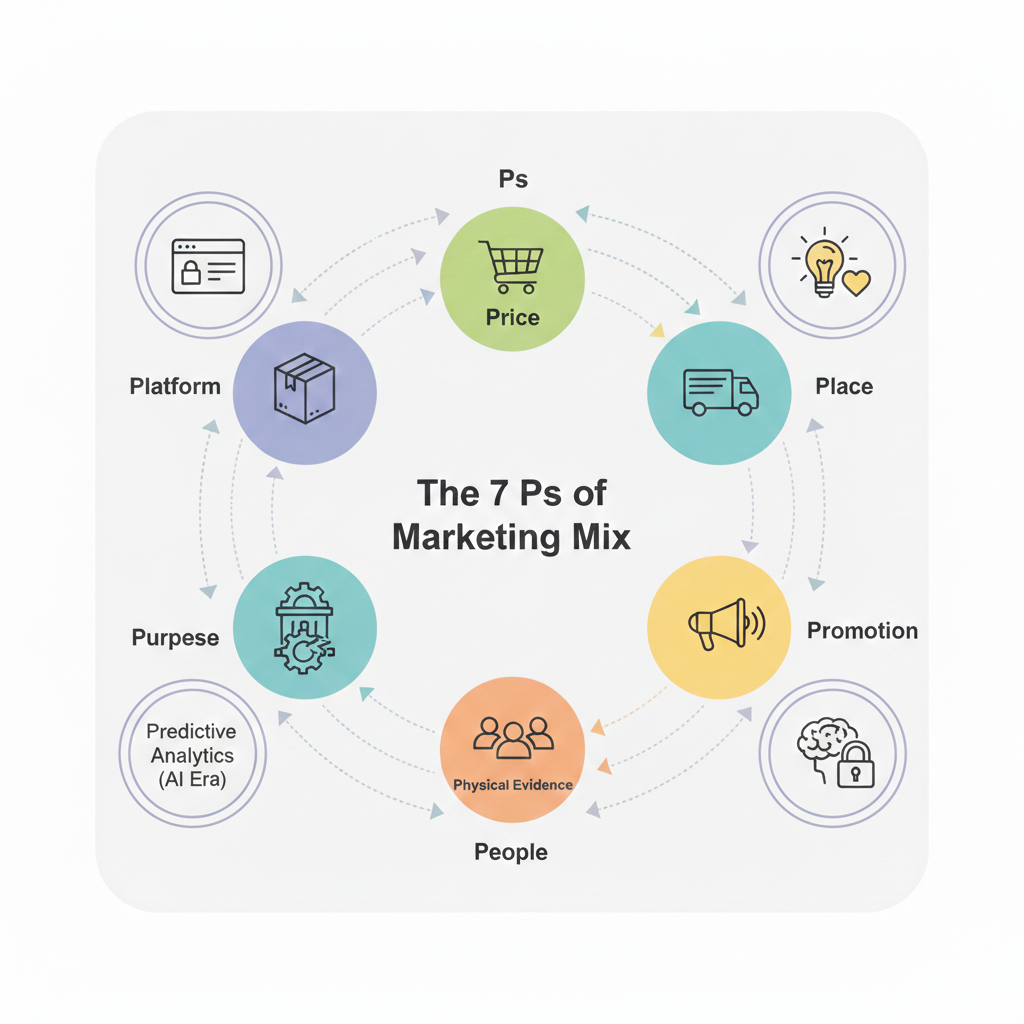
1960s – The Original 4Ps
Introduced by E. Jerome McCarthy, the original framework included:
- Product
- Price
- Place
- Promotion
Why were the 4Ps enough then:
- Manufacturing-driven economy
- Limited competition
- Physical retail dominance
- Mass marketing through TV, print, and radio
Marketing focus: Push products to market efficiently.
1980s – Expansion to 7Ps (Services Boom)
As service industries (banking, hospitality, airlines, healthcare) expanded, the original 4Ps were insufficient.
Three new Ps were added:
- People
- Process
- Physical Evidence
Why were these added:
- Service quality depends on employees (People)
- Service delivery systems matter (Process)
- Intangible services needed tangible proof (Physical Evidence)
Change that happened: Shift from product economy to service economy.
1990s – Relationship Era (Customer-Centric Shift)
Global competition increased. Retention became more important than acquisition.
New focus areas emerged:
- Partnerships
- Personalization
Why:
- CRM systems began emerging
- Loyalty programs grew
- Brands needed long-term relationships
Change: Shift from transaction marketing to relationship marketing.
2000s – Digital Revolution
Internet penetration, e-commerce, and globalization changed everything.
New Ps gained importance:
- Permission (opt-in marketing)
- Performance (ROI measurement)
- Packaging (brand differentiation in cluttered markets)
Why:
- Email marketing requires consent
- Marketing ROI became measurable
- Shelf clutter demanded differentiation
Change: Data-driven marketing began.
2010s – Social & Experience Economy
The rise of smartphones, social media, and experience-led branding transformed marketing again.
New Ps emerged:
- Participation (user-generated content)
- Peer Influence (reviews, influencers)
- Purpose (brand values & social responsibility)
- Platform (digital ecosystems)
Why:
- Consumers co-create brands
- Social proof became powerful
- Brands needed meaning beyond profit
- Platforms (Amazon, Google, Meta) shaped distribution
Change: Marketing became two-way and reputation-driven.
2020s – AI, Trust & Hyper-Personalization Era
Now we are in the AI-led, privacy-sensitive, omnichannel decade.
Emerging critical Ps:
- Privacy
- Predictive Analytics
- Personalization (Advanced, AI-driven)
- Purpose (Deep ESG Integration)
- Phygital Presence (Physical + Digital integration)
Why:
- Data privacy regulations increased
- AI predicts consumer behavior
- ESG matters to investors & customers
- Omnichannel is mandatory
Change: Marketing is now intelligence-led, tech-enabled, and trust-based.
What Is the Most Important “P” for the Current Decade (2020s–2030)?
If one P defines this decade, it is:
Predictive Intelligence
Because:
- AI forecasts consumer behavior
- Data predicts churn & loyalty
- Algorithms drive personalization
- Real-time insights shape campaigns
Marketing is shifting from reactive to predictive.
What Should Brands Include Today?
For CEOs, CMOs, and CXOs, the essential modern Ps to prioritize are:
- Product (innovation-driven)
- Price (dynamic pricing models)
- Place (omnichannel & distribution analytics)
- Promotion (data-led storytelling)
- People (brand culture)
- Process (automation)
- Platform (digital ecosystems)
- Purpose (authentic ESG)
- Privacy (data trust)
- Predictive Analytics (AI-led decisions)
Share this post: