Traditional vs. Advanced Market Research Techniques | FieldNet Global Research
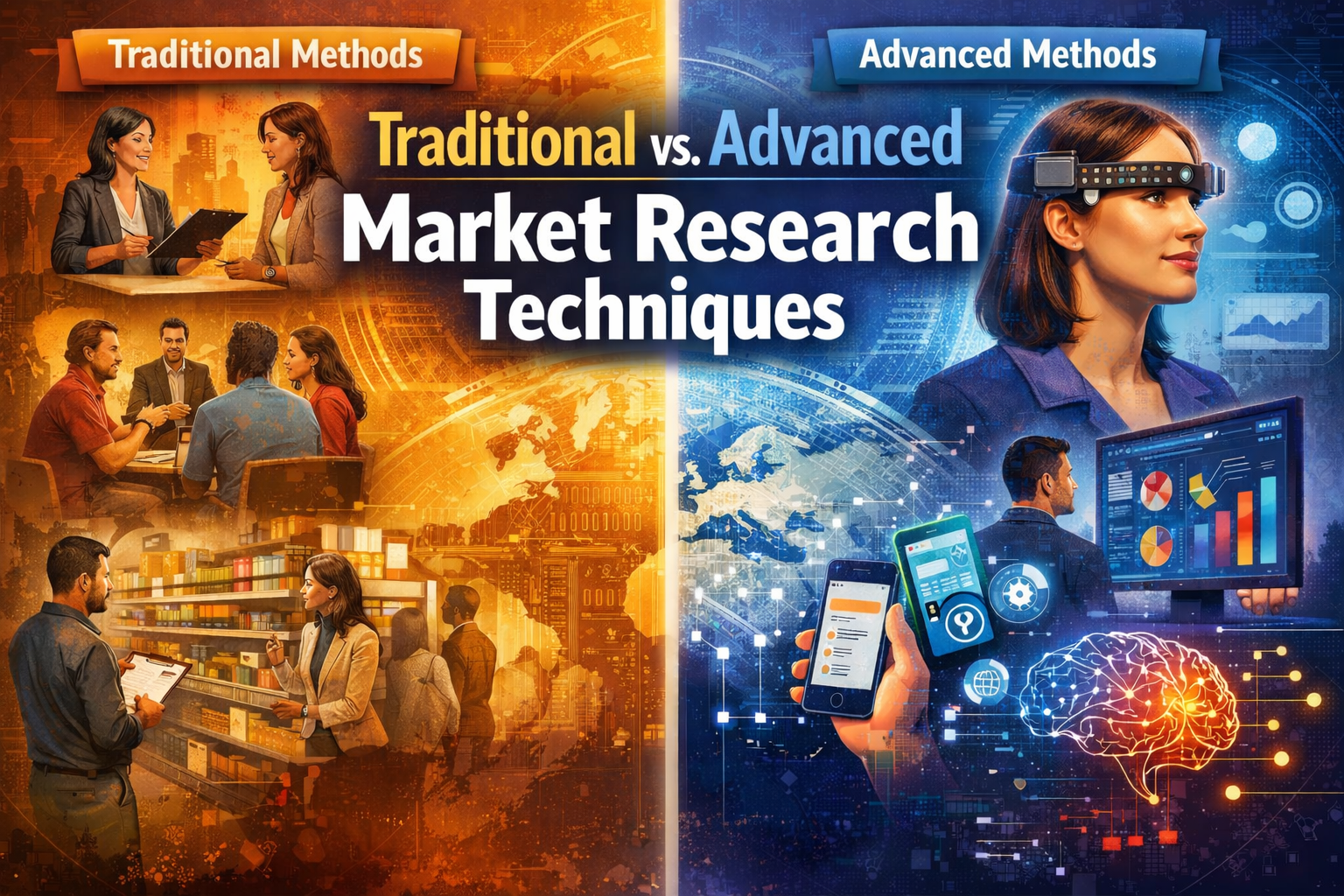
Traditional Market Research Techniques
These time-tested methods form the foundation of the industry. They rely on human interaction, manual data collection, and contextual understanding.
1. Face-to-Face Surveys
Interviewers interact directly with respondents, often in homes, malls, or villages. Ideal for understanding real consumer behavior in diverse geographies.
🟢 Strength: Deep engagement, accurate responses
🔴 Limitation: Costly and time-consuming
2. Focus Group Discussions (FGDs)
Small groups (6–10 people) share views on a topic, guided by a moderator. Perfect for exploring emotions, perceptions, and attitudes toward a product or campaign.
🟢 Strength: Rich qualitative insights
🔴 Limitation: May not represent the entire market
3. In-Depth Interviews (IDIs)
One-on-one discussions with key stakeholders, experts, or high-value consumers. Useful for B2B and exploratory studies.
🟢 Strength: Uncovers hidden motivations
🔴 Limitation: Limited scalability
4. Retail Audits & Mystery Shopping
On-ground evaluation of retail execution; from product display to staff behavior. Widely used by FMCG, retail, and QSR brands.
🟢 Strength: Real-world observation
🔴 Limitation: Labor-intensive and localized
Advanced Research Techniques
Modern research is data-driven, fast, and technology-enabled; turning insights into action at scale.
1. Online & Mobile Surveys
Reach thousands of respondents in minutes through web links, apps, or WhatsApp. Platforms like FieldNet InsightTrack make this seamless.
🟢 Strength: Fast, cost-effective, wide reach
🔴 Limitation: Needs digital literacy
2. Social Listening & Digital Ethnography
Analyze conversations across platforms to understand public sentiment and emerging needs. AI tools scan thousands of comments to uncover trends.
🟢 Strength: Real-time, organic insights
🔴 Limitation: Harder to segment precisely
3. Neuromarketing & Eye Tracking
Measure subconscious reactions to packaging, ads, or UX design. Combines psychology with biometrics for deeper emotional insight.
🟢 Strength: Captures instinctive responses
🔴 Limitation: Requires specialized equipment
4. AI & Predictive Analytics
Use machine learning to predict consumer behavior, price sensitivity, and churn. FieldNet’s AIlytics module converts data into predictive dashboards.
🟢 Strength: Future-focused, data-backed decisions
🔴 Limitation: Needs robust datasets
5. Online Communities & Panels
Build ongoing relationships with target audiences for iterative feedback and rapid testing.
🟢 Strength: Continuous engagement
🔴 Limitation: Requires respondent management
6. Sensor & GPS-Based Audits
Leverage IoT and GPS tracking to verify on-ground research and retail visits.
🟢 Strength: Real-time validation
🔴 Limitation: Higher setup cost
The Hybrid Future of Research
The future isn’t about choosing between traditional and modern; it’s about integrating both. Traditional methods provide depth, while advanced techniques offer speed and scale.
At FieldNet Global Research, we bring these worlds together through:
- Multi-country on-ground studies
- Real-time dashboards
- AI-powered analytics
- Human-led qualitative insights
Because the most powerful decisions come from the perfect balance between human understanding and technological precision.
Final Thought
In today’s fast-moving ecosystem, data without context is noise and intuition without data is risk. Market research bridges the two, ensuring every business decision is grounded in insight.
So, whether you’re a startup building your first product or a global brand redefining strategy, remember: Good research isn’t just information; it’s transformation.
Share this post: