Top 10 Marketing Trends in 2026: What CEOs & C-Level Leaders Must Prepare For
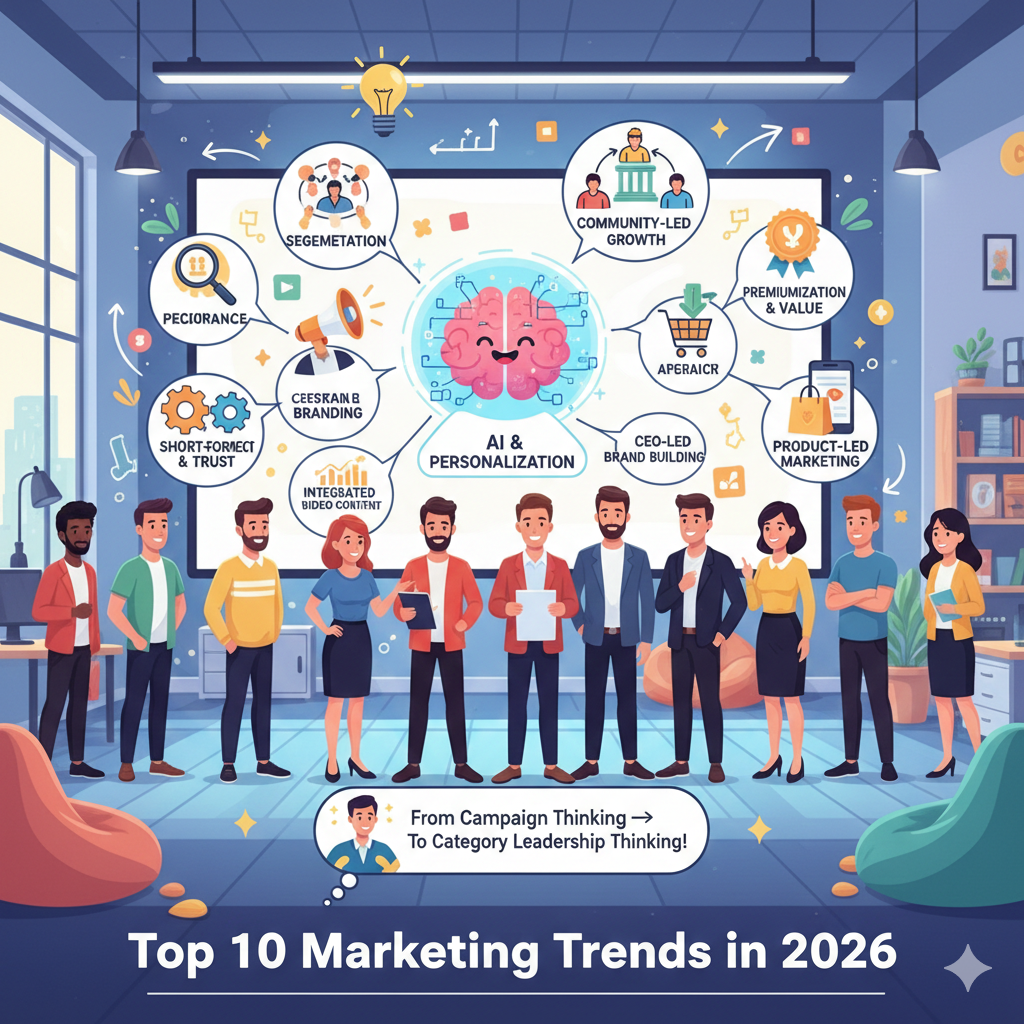
Marketing in 2026 is no longer a department. It is a growth engine directly linked to revenue, valuation, and long-term brand equity.
For CEOs, CMOs, Founders, and C-level executives, marketing decisions today are not about campaigns — they are about customer intelligence, brand positioning, category leadership, and data-driven growth strategy.
Below are the Top 10 Marketing Trends in 2026 that forward-looking organizations must adopt to stay competitive in India and globally.
1. Precision Segmentation Over Mass Targeting
Mass marketing is dead. Hyper-precision segmentation is the new norm.
Brands are no longer targeting “urban millennials” or “SEC A consumers.” They are building micro-segments based on behavior, psychographics, intent data, purchase frequency, and digital footprints.
In 2026, segmentation includes:
- Behavioral segmentation
- Need-state segmentation
- Occasion-based segmentation
- Value-based segmentation
- Digital consumption clustering
Executives who invest in an advanced market segmentation strategy will see better brand positioning, higher conversion rates, and stronger customer lifetime value (CLV).
2. AI-Integrated Marketing Decision Systems
Artificial Intelligence is no longer experimental — it is embedded into:
- Media planning
- Campaign optimization
- Creative testing
- Pricing simulations
- Demand forecasting
In 2026, leading brands are using AI-driven marketing analytics dashboards that combine sales data, social listening, consumer insights, and competitive tracking in real time.
Marketing is shifting from reactive to predictive.
3. CEO-Led Brand Building
One of the strongest marketing trends in 2026 is CEO personal branding.
Consumers and investors now evaluate:
- The founder’s vision
- The leadership credibility
- The brand narrative from the top
C-level executives who actively communicate on professional platforms build:
- Investor trust
- Employer brand strength
- Industry authority
- Organic brand visibility
Brand equity is increasingly tied to leadership visibility.
4. Community-Led Growth Models
Instead of traditional awareness campaigns, brands are building:
- Private digital communities
- Insider product testing groups
- Beta user ecosystems
- Loyalty micro-clubs
Communities generate:
- Faster product feedback
- Higher retention
- Organic advocacy
- Stronger repeat purchase behavior
Community marketing is becoming a core retention strategy.
5. Performance Branding (Brand + ROI Integration)
The false divide between brand marketing and performance marketing is disappearing.
In 2026:
- Brand storytelling is measurable.
- Performance campaigns build long-term equity.
- Attribution models are multi-touch and data-backed.
Smart marketers are aligning: Brand Awareness → Consideration → Conversion → Loyalty → Advocacy
All linked to revenue dashboards.
6. Premiumization & Value-Driven Positioning
Indian consumers — especially Gen Z and millennials — are increasingly willing to pay for:
- Quality
- Transparency
- Ethical sourcing
- Innovation
- Design
However, they expect clear communication of value.
Brands must clearly articulate:
- Why are they premium
- What differentiates them
- How do they solve real consumer problems
Positioning clarity is now a survival factor.
7. Consumer Psychology-Driven Marketing
Marketing in 2026 is rooted in behavioral science.
Successful brands understand:
- Decision fatigue
- Loss aversion
- Social proof
- Trust triggers
- Emotional anchors
Instead of just demographics, companies are investing in consumer behavior research, ethnographic studies, and real-life immersion insights to understand why people buy.
Psychology-led marketing improves messaging precision and brand recall.
8. Product-Led Marketing Strategy
Marketing begins at product design.
Organizations are integrating:
- Early-stage product testing
- Concept validation research
- Prototype feedback loops
- In-market usage studies
Instead of launching and then marketing, brands now: Research → Build → Test → Optimize → Scale
Product innovation and marketing strategy are becoming one unified function.
9. Data Transparency & Trust Marketing
Consumers in 2026 demand:
- Honest pricing
- Clear ingredient disclosure
- Data privacy assurance
- Ethical brand conduct
Trust is measurable. Net Promoter Score (NPS), repeat purchase rate, and sentiment analysis are core KPIs at the board level.
Brands that communicate openly build durable equity.
10. Integrated B2B & B2C Marketing Intelligence
The distinction between B2B and B2C marketing is blurring.
B2B buyers now expect:
- Personalized journeys
- Content authority
- Data-backed value propositions
- Emotional brand credibility
Meanwhile, B2C brands adopt:
- Account-based marketing principles
- CRM precision
- Lifecycle targeting
In 2026, marketing intelligence platforms will integrate seamlessly with both ecosystems.
What This Means for CEOs & C-Level Leaders
Marketing is no longer:
- Just advertising
- Just social media
- Just branding
It is:
- Revenue architecture
- Competitive intelligence
- Consumer understanding
- Long-term enterprise value creation
Organizations that align market research, brand strategy, digital analytics, and customer behavior insights will dominate their categories.
Final Thought
The biggest shift in 2026 marketing is this:
From Campaign Thinking → To Category Leadership Thinking.
Brands that understand their consumers deeply, position sharply, innovate continuously, and measure intelligently will not just grow — they will define the market.
Contact Fieldnet for more details.
Related Article
Share this post: