Cluster Sampling in Market Research: Definition & Examples | FieldNet Global
Definition, Method, Examples & When to Use It
In large and diverse markets, collecting data from every individual is often impractical. This is where cluster sampling becomes a powerful and cost-effective research methodology.
For CXOs, product managers, and research leaders, understanding cluster sampling helps design studies that are scalable, efficient, and statistically valid—without compromising insight quality.
This guide explains:
- What cluster sampling is
- How cluster sampling works
- Types of cluster sampling
- Real-world use cases in market research
What Is Cluster Sampling?
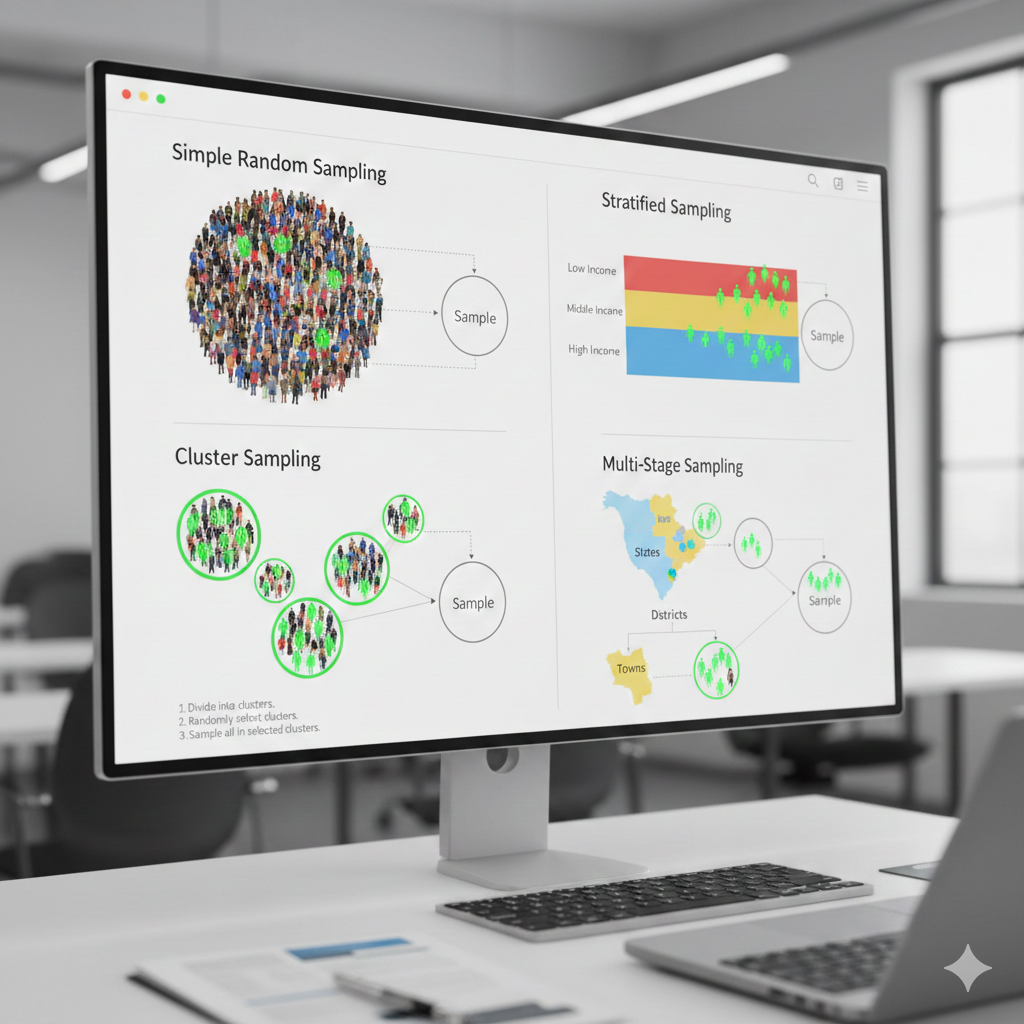
Cluster sampling is a probability sampling technique where the total population is divided into groups (clusters), and a random selection of clusters is chosen for data collection.
Instead of sampling individuals across the entire population, researchers study entire clusters or samples within selected clusters.
Clusters are usually defined by:
- Geography (cities, districts, villages)
- Stores or outlets
- Schools, offices, or institutions
- Housing societies or blocks
Why Cluster Sampling Is Used in Market Research
Cluster sampling is commonly used when:
- The population is geographically dispersed
- A complete list of individuals is unavailable
- Field execution costs need to be optimized
- Large-scale studies are required
For emerging markets, cluster sampling enables ground-level coverage at scale.
How Cluster Sampling Works (Step-by-Step)
- Define the target population(e.g., FMCG shoppers in India)
- Divide the population into clusters(e.g., cities → wards → villages → retail clusters)
- Randomly select clusters(not individuals at this stage)
- Collect data from:
- All units within selected clusters, or
- A random sample within each cluster
- Aggregate and analyze data
This structure makes cluster sampling operationally efficient for field-based research.
Types of Cluster Sampling
1. Single-Stage Cluster Sampling
All units within selected clusters are surveyed.
Example:Selecting 50 villages and interviewing every household within those villages.
Used when:
- Clusters are small
- Deep coverage is required
2. Two-Stage Cluster Sampling
Clusters are selected first, then a sample of units within each cluster is chosen.
Example:Selecting 30 cities → sampling 100 consumers per city.
Used when:
- Clusters are large
- Cost and time efficiency is critical
3. Multi-Stage Cluster Sampling
Sampling happens across multiple levels.
Example:State → District → Town → Ward → Household
This is common in national-level studies, electoral research, retail audits, and rural research.
Cluster Sampling vs Other Sampling Methods
Method
Key Difference
Simple Random Sampling
Individuals selected directly
Stratified Sampling
Population divided by characteristics
Cluster Sampling
Groups (clusters) selected first
Key distinction:Cluster sampling prioritizes operational feasibility, while stratified sampling prioritizes population representation.
Advantages of Cluster Sampling
- Cost-effective for large populations
- Easier field execution
- Reduces travel and logistics complexity
- Suitable for large-scale and multi-location studies
Limitations of Cluster Sampling
- Higher sampling error than simple random sampling
- Results depend heavily on how clusters are defined
- Requires strong methodological control
This is why cluster sampling must be designed carefully, not mechanically applied.
When Should Brands Use Cluster Sampling?
Cluster sampling is ideal for:
- FMCG and retail research
- Rural and semi-urban studies
- Store audits and census studies
- Large consumer tracking programs
- Infrastructure, healthcare, and education research
For decision-makers, it enables scale without losing control.
How FieldNet Global Applies Cluster Sampling
FieldNet Global uses cluster sampling as a strategic design tool, not just a statistical technique.
Our approach includes:
- Scientifically defined clusters
- Ground-level validation
- Hybrid quantitative + observational models
- Technology-enabled field tracking
This ensures representative insights, even in complex and fragmented markets like India and APAC.
Frequently Asked Questions (FAQ)
What is cluster sampling in simple terms?
Cluster sampling involves dividing a population into groups and randomly selecting some groups for data collection instead of sampling individuals directly.
Is cluster sampling probability sampling?
Yes, cluster sampling is a probability sampling method when clusters are selected randomly.
When is cluster sampling better than stratified sampling?
Cluster sampling is better when populations are geographically spread and field execution costs are high.
Key Takeaway
Cluster sampling enables scalable, efficient market research—but only when designed correctly.For leadership teams, it balances cost, coverage, and decision reliability.
Planning a Large-Scale Study?
If you’re designing a national, multi-city, or rural research project, FieldNet Global can help you build a statistically sound and operationally feasible sampling framework.
👉 Enquire now to discuss your research design.
Share this post: